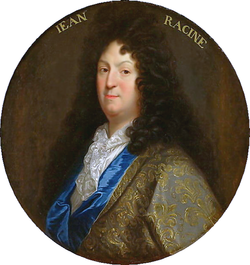
Jean Racine, "Prefaces" (1668; 1670)
Jean Racine (1639-1699) was a French dramatist, who primarily wrote tragedies. In the prefaces to his plays, Racine addressed some general issues to do with drama as well as issues particular to each play.
…However that may be, the public has treated me so well that I am not bothered by the disappointment of two or three individuals who would have us re-cast all the heroes of antiquity and make them paragons of perfection. I think their intention of putting only such bothered by the disappointment of two impeccable examples of humanity on the stage admirable, but I beg them to remember that it is not for me to change the laws of the drama. Horace tells us to describe Achilles as ferocious, inexorable, violent—as he actually was. And Aristotle, far from asking us to portray perfect heroes, demands on the contrary that tragic characters—whose misfortunes bring about the tragic catastrophe—should be neither wholly good nor wholly bad. He does not want them to be extremely good, because the punishment of a good maxi would excite indignation rather than pity in the audience; nor that they be excessively bad, because there can exist no pity for a scoundrel. They must therefore stand midway between the two extremes, be virtuous and yet capable of folly, and fall into misfortune through some fault which allows us to pity without detesting them.
…Personally, I have always believed that since tragedy was the imitation of a: complete action—wherein several persons participate—that action is not complete until the audience knows in what situation the characters are finally left. Sophocles always informs us of this: in the Antigone he writes as many lines to show Hæmon's fury and Creon's punishment after the death of the princess, as I have written in Agrippina's imprecations, the retreat of Junia, the punishment of Narcissa and the despair of Nero, after the death of Britannicus.
How could these difficult judges be pleased? It would be an easy task, had I wished to violate commonsense a little. I should have but to abandon the natural for the extraordinary. Instead of a simple plot, with very little material—as befits an action supposed to take place within the compass of a single day and which, proceeding by degrees toward the end, is sustained solely by the interest, sentiments, and passions of the characters—I could just as well have crowded the very same story with a number of incidents which could not actually have happened within a whole, month, with any number of stage-tricks, as astonishing as they would be false to nature, with a number of declamatory passages wherein the actors would utter the exact opposite of what they ought to utter. I might, for instance, have represented some hero as drunk, wishing to make his mistress hate him, out of sheer caprice; or a mouthing Lacedæmonian, a conqueror scattering maxims upon love; a woman giving lessons in pride to a warrior—in any of these ways I might have satisfied the gentlemen. But what would that small group of intelligent people whom I must please, have said? How would I have dared appear, so to speak, before those great men of antiquity whom I have taken for my models? Because, when I make use of their thoughts, I think of them actually as spectators. When we take our inspiration from them we should always ask ourselves, "What would Homer and Vergil say, if they were to read these lines? What would Sophocles say if he saw this scene?" However all this may be, I have never tried to prevent anyone's criticizing my works adversely; that would be impossible: Quid de te alii loquantur ipsi videant, says Cicero, sed loquentur tamen: "Others must be careful how they speak of you; but be sure that they will speak of you, in some way or other."
I only beg tbe reader's forgiveness for this little preface, which I wrote merely to explain and justify my tragedy. What more natural than to defend oneself when one believes oneself unjustly attacked? I think that Terence wrote his prologue solely to justify and defend himself against the critics who spoke in disparagement. of the old poet of evil intentions, malevoli veteris poetae, and who came to raise their voices against him, up to the very moment his comedies were performed.
…occoepta est agi:
Exclamat, etc.
"Hardly has the curtain risen, but there he is, crying out," etc. (Prologue to the "Eunuchus" of Terence.)
There is one objection which might have, but has not, been urged against me. Still, what escaped the spectators may become evident to the reader: I make Junia join the Vestals. Now according to Aulus Gellius the Vestals received no one under six years of age, nor over ten. But here the people take Junia under their protection, and I thought that in consideration of her rank, her virtue, and her misfortune, an exception might be made regarding her age, as other exceptions had been made in the cases of so many men who deserved to be made consuls.