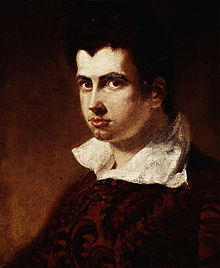
Leigh Hunt, "On the Acting Styles of Kemble and Kean" (1831)
Leigh Hunt (1784–1859), poet, dramatist, and essayist, writing in The Tatler, compares the acting style of classical actor John Kemble (1757–1823), with that of the great tragic actor Edmund Kean (1787–1833), who made his debut as Shylock at Drury Lane in 1814.
We believe it was the opinion of a great many besides ourselves that Kean did extinguish Kemble: at all events, we hold it for certain that Kean hastened his going out; and we are greatly mistaken if Kemble did not intimate as much to his friends, putting the case as Quin did on a like occasion respecting Garrick,—that new notions had come up in acting, and that if , those were true, it was time for the teachers of the old ones to be gone. Garrick's nature displaced Quin's formalism: and in precisely the same way did Kean displace Kemble. The opinion is no new one on our parts, nor on those of many others. We, expressed it at the time. We always said that John Kemble's acting was not the true thing; and the moment we heard what sort of an actor Kean was (for circumstances prevented our seeing him at the moment) we said that he would carry all before him. It was as sure a thing as Nature against Art, or tears against cheeks of stone.
We do not deny a certain merit of taste and what is called "classicality" to John Kemble. He had one idea about tragedy, and it was a good one; namely, that a certain elevation of treatment was due to it, that there was a dignity, and a perception of something superior to common life, which should justly be regarded as one of its constituent portions; and furthermore, that in exhibiting the heroes of the Roman world, it was not amiss to invest them with the additional dignity they had received from the length of their renown and the enthusiasm of scholarship. These ideas were good: and as he had a fine person, a Roman cast of countenance, and equal faith in the dignity of his originals and his own, he obtained, in the absence of any greater and more natural actor, a whole generation for his admirers, many of whom could not bear to give him up when the greater came. This is the whole secret of the fondness entertained for his memory. It is a mere habit and a prejudice, though a respectable one; and we should be the last to quarrel with it were nature let alone. It is observable that Mr. Kemble's admirers never enter into any details of criticism or comparison. They content themselves with a fine assumption or two, like his own—a stately or sovereign metaphor—and a reference to his gentility. Now Mr. Kemble had a solemnity of manner off the stage, analogous to what he had on it, and we believe he kept "good company," in the ordinary sense of that phrase; but that he was more of a gentleman than Mr. Kean, either in his strongest or weakest moments, we have yet to learn. Allusions are frequently made to a habit in Mr. Kean, which his predecessor certainly shared with him, though with comparative harmlessness to his less sensitive temperament. On the other hand (for we never saw him in private) Mr. Kean, we believe, is as much of a gentleman in ordinary as Kemble was; and we have heard accounts of his behaviour to his brother actors and inferiors, which argue an inner gentility—a breeding of the heart—which at all events we never did hear of the other. In the power of appreciating moral and intellectual refinement, we should say that there could be no sort of comparison between the man who can act Othello as Kean does, and the dry, tearless, systematical, despotical style of all Mr. Kemble's personations. Everything with Kemble was literally a personation —it was a mask and a sounding-pipe. It was all external and artificial. There was elegance, majesty, preparation: it was Gracchus with his pitch-pipe, going to begin—but nothing came of it. It was not the man, but his mask; a trophy, a consul's robe, a statue; or if you please, a rhetorician. It was Addison's "Cato," or an actor's schoolmaster, which you will; but neither Shakspeare nor genuine acting.
The distinction between Kean and Kemble may be briefly stated to be this: that Kemble knew there was a difference between tragedy and common life, but did not know in what it consisted, except in manner, which he consequently carried to excess, losing sight of the passion. Kean knows the real thing, which is the height of the passion, manner following it as a matter of course, and grace being developed from it in proportion to the truth of the sensation, as the flower issues from the entireness of the plant, or from all that is necessary to produce it. Kemble began with the flower, and he made it accordingly. He had no notion of so inelegant a thing as a root, or as the common earth, or of all the precious elements that make a heart and a life in the plant, and crown their success with beauty. Grace exalts the person of Kean. In Kemble's handsomer figure it came to nothing, because it found nothing inside to welcome it. It received but "cold comfort." Kean's face is full of light and shade, his tones vary, his voice trembles, his eye glistens, sometimes with withering scorn, sometimes with a tear: at least he can speak as if there were tears in his eyes, and he brings tears into those of other people. We will not affirm that Kemble never did so, for it would be hard to say what Shakspeare might not have done in spite of him; but as far as our own experience goes we never recollect him to have moved us except in one solitary instance, and that was in King Lear, where there is the fine passage about children's ingratitude and the tooth of a serpent. Now Kean we never see without being moved, and moved too in fifty ways—by his sarcasm, his sweetness, his pathos, his exceeding grace, his gallant levity, his measureless dignity: for his little person absolutely becomes tall, and rises to the height of moral grandeur, in such characters as that of Othello. We have seen him with three or four persons round him, all taller than he, but himself so graceful, so tranquil, so superior, so nobly self-possessed, in the midst, that the mind of the spectator rose above them by his means, and so gave him a moral stature that confounded itself with the personal.